Monday, October 3, 2011

Robust Rye Porter

The second beer of my first Salt Lake brewday was another dark beer to welcome the coming cooler months (which haven’t really made much of an appearance here yet).  I love porters with good chocolate notes and restrained but present roast; Great Lakes Edmund Fitzgerald and Founders Porter are always welcome in my glass.  Along with those specifications, I also wanted to include a (nearly obligatory now) significant portion of rye.  This is a recipe I’ve had on the books for quite some time, and I’m happy to have had the opportunity to finally brew it.

The base of this beer was equal parts 2-row and rye malt, with nearly as much brown malt for a “classic” porter toastiness.  The 2-row I got here is from Malteurop; according to my new LHBS, they preferred it in a side-by-side brewing with Rahr’s 2-row, which is a bit more expensive; at some point I’ll make something lighter and more pale malt-forward to check for myself, but for now it’s worked out just fine.  The small amount of black patent and American chocolate (lighter in colour and flavour than UK chocolate) add to that restrained roast presence.  Northern Brewer hops provide solid bitterness and perhaps a touch of mint, and the WLP007 ferments out well.

Other than some mash hangups in the second sparge, the brewing went well.  I got a late start with the starter--sadly, the pun is unintended--so in lieu of waiting too long after brewing to pitch, I picked up a second vial of yeast to start off things, then pitched the starter when it was ready to go.  The higher gravity (as compared to the dry stout) will help to pass the coming colder nights.  I love hoppy beers, but I’m looking forward to enjoying these dark, malty treats as the leaves change.

Robust Rye Porter
Batch size: 5 gallons
Projected OG: 1.060
Projected SRM: 33.3
Projected IBU: 45.6
Boil time: 60 minutes
Brewhouse efficiency: 80%

Grains
34.8% - 4 lb 2-row
34.8% - 4 lb Rye
26% - 3 lb Brown malt
2.2% - 4 oz Black patent
2.2% - 4 oz American chocolate

Hops
1 oz Northern Brewer (10.5%) (60 min)
.5 oz Northern Brewer (15 min)

Yeast
WLP007 Dry English Ale - 3.5L starter

Water additions (mash)
6 qts RO water

Brewday: 3 September 2011
Mash-in: 14.5 qts @ 154F for 2 hours - dropped to 148F
Pre-boil volume: 6 gallons
Pre-boil SG: 11.8P (1.047)

Into swamp cooler at 65F; waiting for starter to settle out for pitching.

Still waiting for the starter to finish out 20 hours later, so pitched a second (much fresher) tube of 007 for now.

Pitched the starter 27 hours after chilling.

Bottled: 24 September 2011

FG: 1.018
ABV: 5.5%
Bottled 4.8 gallons with 3.5 oz table sugar.

Friday, September 30, 2011

SLC Dry Stout

Other than working through my backlog of vintage bombers--I bottle one from each batch, and had them stretching back three years and understandably some have stood the test of time better than others–our homebrew consumption has been limited to IPAs and lacto-soured beers since we got to town. Ready for a change of pace, my first Salt Lake City brewday was devoted to the other end of the spectrum: dark, roasty, and malty.

The first beer in the mashtun was a fairly conventional dry stout. Last year’s stouts taught me to stick with darker British roast malts for these beers; the depths of darkness they impart do not disappoint. The water report here shows a lot of minerals coming out of the tap, so I cut that supply with a significant portion of RO water. Cereal mashing still gives me the willies, for some reason; it was probably unnecessary in this case, but I went through it anyway with my flaked barley. Moderate bittering came from Challenger and Northern Brewer, and Nottingham yeast came in to give a light English flavour and flocc out quickly.

I did another overnight mash for this one to move along the brewday, particularly as I also brewed a robust rye porter following the stout. It took a little while to get my bearings brewing in our new digs, but it’s really nice to have the turkey fryer set up right outside the kitchen door, all of maybe ten feet from the sink. The beer sat waiting to be bottled for an extra week and a half past when I wanted to get it bottled, but no harm was done. Just waiting for this batch (and its brother porter) to carb up and get us in the mood for our first Mountain Time Zone autumn.

SLC Dry Stout

Batch size: 5.25 gallons
Projected OG: 1.044
Projected SRM: 32.4
Projected IBU: 31.7
Boil time: 60 minutes
Brewhouse efficiency: 83%

Grains
62.5% - 5 lb 2 row
25% - 2 lb Flaked barley
6.25% - 8 oz UK RB
6.25% - 8 oz UK Chocolate

Hops
.5 oz Northern Brewer (10.5%) (60 min)
.5 oz Challenger (7.2%) (60 min)

Yeast
1 pkg Nottingham


Water additions (mash)
4 qts RO water


Brewday: 3 September 2011
Cereal mash: Flaked barley and 1 lb 2-row with 5 qts @ 125F for 15 minutes.
Heat slowly to 165F and add to main mash
Mash-in: 5 qts (plus 5 qts in cereal mash) @ 154F overnight
1st sparge: 10 qts @ 200F
2nd sparge: 10 qts @ 180F
Pre-boil volume: 6 gallons
Pre-boil SG: 8.8P (1.035)

Into swamp cooler in low 60s; activity within 15 hours.


Bottled: 25 September 2011
FG: 1.011
ABV: 4.3%
Bottled 5 gallons with 3 oz table sugar.

Sunday, September 11, 2011

Utah Beer Tasting

This evening DeAunn and I sampled three offerings from two of Utah’s premiere breweries, Epic and Uinta Brewing Companies.  While not all of the beers we tried were necessarily to our tastes, they all were flavourful and worth trying; at least two of them we’ll have to try again.

Epic Brewing’s Sour Apple Saison: Voluminous cumulous head on a golden bodied beer.  Big wheat & nearly hefeweizen aroma.  Did not taste of sour apple, but big estery quality of Saison Dupont (of which we’re not really fans; in yeast terms, we both prefer French to Belgian saison strains).  Lots of light fruit and a quenching finish, but overwhelmed by an almost celery flavour we get from wit yeasts.  Not our favourite.

Epic Brewing’s Brainless With Cherries: Small white head that dissipates even on pouring with a rich ruby beer.  Aroma starts with big cherry, but later transitions to a metallic aroma.  Flavour is heavily toward a Duvel-type Belgian golden strong; some cherry left late on the tongue.  Alcoholic, to be sure; tasty, and worth another sampling.

Uinta Brewing’s Crooked Line Series - Cockeyed Cooper Bourbon Barrel Barley Wine Ale: Pours deep amber with little head.  Aroma of heavy bourbon and bittering hops; smells like it weighs in as a young Sierra Nevada Bigfooot.  In tasting, though, it’s much more mellow; heavy bittering hops are subdued with a boozy, malty flavour coming through.  Finish is relatively bitter, but very enjoyable.  Definitely worth having young, and possibly putting away for a year and trying against a fresh bottle.

Friday, September 9, 2011

Home toasting malt

Three years ago I started growing hops in an effort to take a more active role in controlling my ingredients.  While we lack the real estate (and time and resources) to do any growing and malting of grain, we do have the ability to tweak some malt by home toasting it.

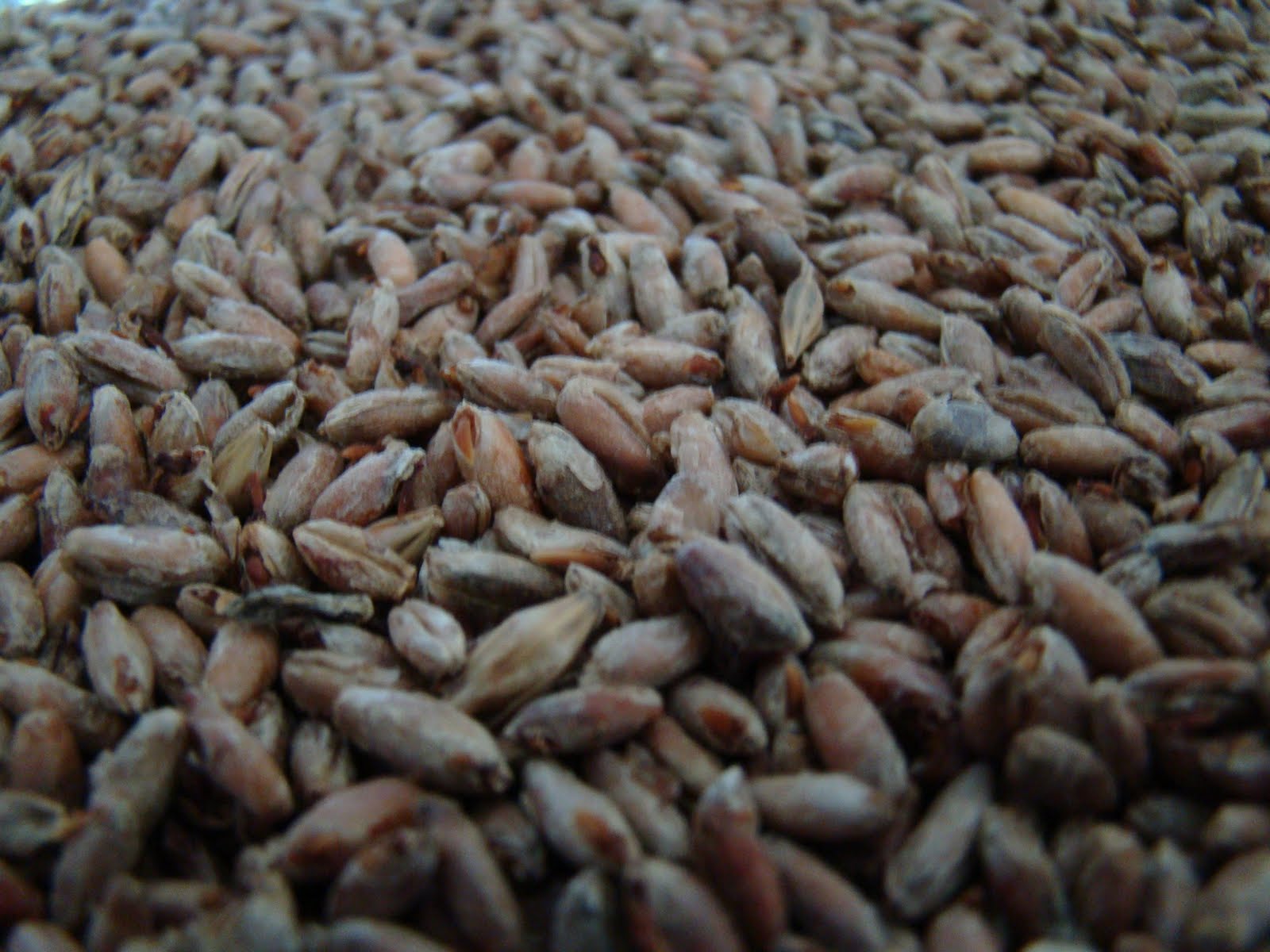
As previous posts indicate, malted rye is a grain in which I have a great interest.  I have a couple all-rye beers on the schedule in the next month or so, and toasting a small amount of rye malt sounded like a good proposition to add additional character to what will be essentially a Scottish 60/-.  As there won’t be much to the grist of this beer–just over six pounds total–I toasted just one pound to use as an accent.  Half a pound was dry toasted for a biscuit flavour; the other half pound I prepared as a light crystal malt.

A number of sources delve into toasting your own malt, including Randy Mosher’s ever-excellent Radical Brewing and John Palmer’s trusty How To Brew.  I followed Palmer’s method this time out, which is pretty
straightforward. There are other, more involved methods out there for making crystal malt that most likely create a sweeter, more accurately caramel flavour; depending how this batch turns out, I may try one of them next time.  To be fair, Palmer doesn't stipulate this as the way to make crystal malt, but as a way to produce more caramel flavour than dry toasting.  Smelling and tasting the grain just out of the oven and over the last couple days, though, I’m pretty happy with what I have right now.

The rye filled the house with an incredible bready, nutty aroma as it was toasted; I’d recommend doing this just for the domestic aromatics alone.  The dry toasted rye had a pleasing, light roasty/toasty flavour, though shy of a Biscuit or Victory malt.  The crystal rye was sweet, nutty, and had a touch of fruitiness to it.  I’ll be very interested to see how these grains impact this very uncomplicated grain bill.

For dry toasted malt: Make a shallow grain bed in a foil-lined pan and put in 350F oven for 30 minutes, turning grain after 15 minutes.

For crystal malt (~20L): Soak grain in filtered water for 1 hour.  Strain, then make a shallow grain bed in a foil-lined pan and put in 350F oven for 1 hour, turning grain every 15 minutes.

Most sources recommend storing the toasted grain and agitating it daily for two weeks before using it to allow the harsher aromatics to dissipate.

Friday, August 26, 2011

How to kill hop bines

In planning our move to Salt Lake City for doctoral school, we decided to keep our 3-year-old hop plants; we figured they’d be difficult to transport (each planter has 90 pounds of soil in it) but it would’ve been a shame to leave them just after they started really producing.  They hadn't seen anything but ambient rainfall for the three weeks just before the move, as we'd been out of town, and they seemed to be doing just fine with that level of neglect; they seemed more than hardy enough to make the move.  We were towing my car behind the moving truck, so just before leaving, I put down a tarp in the back seat and lugged them all into it; at least there I could water them and they could get some sunlight.

After four days of travel from Chicago, though, the bines were showing some serious fatigue.  Particularly on our last day of driving, out of Colorado and across the arid Utah flats, they visibly shriveled in the driest air they’d ever experienced.  Once we arrived, our priority was unpacking, getting the new house livable, and taking all manner of entrance exams and placement auditions.  My car got pulled around back and out of the way, but it was several days before I had a chance to talk to our new landlord about putting them out.  Thankfully, he had no problems with the plants or their placement on the south face of the house, so I finally pulled them out of the car and put them back in the open air.

By then, though, the damage was done.  I’d tried to keep them pretty well watered before I was able to get them out of the car, but they were pretty fried from the dry heat and lack of full sun.  The bines were pretty well dried out, the hops all browned or browning.  I kept them pretty well drenched, but that didn’t do much for the crispy bines.  However, hope springs eternal: new green shoots appeared near the bases of the bines on all three plants.  Looks like the root systems are still doing well.  Yesterday, I cut down the dead bines to let the new shoots grow unimpeded.  I don’t expect them to produce any more cones this year, but it should be interesting to see how much they do grow before autumn really puts them out of commission for the season.  I’m looking forward to seeing what the Utah weather does for them next spring.  For now, it's time to get acquainted with the area, the school, and plan the first Utah batches.

Tuesday, August 2, 2011

Sour Rye Saison

For my last Chicago brewday, I was looking to make a beer that would refresh us as we unpack in our new place in Salt Lake City.  Given how well last summer’s saison went over, another one, lower in gravity, was in order.  Rye has found a solid place in my brewery over the last year, adding its spiciness and slick mouthfeel, so I wanted to make it a major player in this recipe.

I was also intrigued by how the Cherry Sour turned out following a long sour worting; it produced a prominent, very clean lactic sourness.  While using a neutral ale yeast made for a fairly one-dimensional end product, it seemed this method, applied gently, could add another layer of complexity to what the saison yeast would contribute.  I had just a couple ounces of Amarillo hops left to help build on the citrus character of the sour worting; to augment this I made my first foray into the world of New Zealand hops by adding an ounce of Pacific Jade, known for their citrus and black pepper notes (which should go well with the yeast).

When I started using rye, I followed conventional wisdom in keeping the percentage low to limit its purported gumminess from stopping up the mash.  After reading about a beer made with 100% malted rye, I went bigger; I did an English bitter made almost entirely of rye, and from then on I haven’t had any of the mashing/sparging problems attributed to rye (or wheat, for that matter).  Or at least I hadn’t until this brewday.

I mashed low to keep the final beer dry, as I did with the previous saison; despite the high percentage of rye in the mash and being in the temp range that can make its proteins so notoriously gummy, my experience with my system gave me confidence that I’d come sailing through this without incident.  On top of that, my poorly insulated mashtun lost almost 15 degrees (F) during the long mash.  The time came to start the vorlauf; I attached the hose, opened up the valve per usual, and after the first small surge, it slowed to a trickle.  Minutes
went by, and next to nothing came out.  I stirred the mash, I blew back through the tube, but nothing got it moving.  So I resorted to a method I consider fairly un-French; I decocted.

This traditional German technique is used to raise the mash temperature by drawing off a thick portion of the mash (lots of grain, a little wort), boiling it, then adding it back to the main mash; it also tends to increase mash efficiency and produce maltier beers.  I’ve only decocted once, to add extra maltiness to a small batch of weizenbock; in this case, though, I figured raising the mash temperature to “unglue” the rye proteins was my best bet and this was the only option I had for doing that on my setup.  Unfortunately, the first decoction of just a couple quarts of thick mash didn’t have much effect at all, not even getting it back up to mash temp.  So I doubled the size for the second decoction, which bumped up the temp to 160F.  And the runoff was still interminably slow.

Eventually, I just brought the water for the first sparge to a boil and put it in on top of the mash, bringing the temp to 176F.  That’s hot enough to start extracting unwanted tannins from the grains, but I hoped it would also be hot enough unstick the damn rye.  And the runoff was STILL slow...but moving.  The brewday ended up much longer than planned, but I was able to collect my runnings and get the thing to the boil.  Between the Munich malt and the decoctions, this will probably fall on the maltier side of things than saisons normally do.

Of course, since I was sour worting this beer, I wasn’t even close to the end.  After a 20-minute boil to get past the hot break and sterilize the wort, I cooled it down to about 115F, pitched my lacto starter, covered it with plastic wrap, and put it in the swamp cooler to let the bugs stew just overnight.  The next day I found that I must’ve done a pretty poor job keeping the plastic wrap right down on the wort (to inhibit unwanted bugs that need oxygen, like acetobacter), as the wort had a frizzy, frothy head unlike the thick, controlled scum that showed up on the Cherry Sour.  Still, it didn’t smell out of bounds, so to speak, and it was about to get a full 60-minute boil, so I didn’t worry too much about it.

The normal boil proceeded without incident, other than it seemed impossible to keep this one from boiling over; even though I’d boiled it past the hot break before souring, the head as it came to boil was immense, it still billowed up despite spritzing with a water bottle and keeping the flame low, and it persisted to some degree through the end of the boil.  I chilled and set it aside, but was unable to get back to it for almost a full day.  Eager to avoid a double souring, I brought it back to a short boil and chilled it again; on reheating, it had
a really wonderful, gentle fruit aroma that I attribute to the late hops.

Primary fermentation chugged away, and the dry hops went in right on top when it subsided.  I’d only planned to have them in there for about 5 days, but with us busy packing, painting and cleaning for the imminent move, I didn’t have a chance to bottle before leaving for my music festival.  By the time we get back, they will have had 3 ½ weeks of contact time.  After all the hassle of this brew session, I’m looking forward to bottling this one, along with the Russian imperial stout, which has been sitting on oak for 2 months now.

Sour Rye Saison
- Farmhouse ale with lacto starter

Batch size: 5.5 gallons
Projected OG: 1.048
Projected SRM: 8.4
Projected IBU: 28.9
Boil time: 60 minutes
Brewhouse efficiency: 80%

Grains
50% - 5 lb Rye malt
50% - 5 lb Munich

Hops
1 oz Amarillo (7.8%) (20 min)
.5 oz Amarillo (10 min)
.5 oz Pacific Jade (13.4%) (10 min)
.5 oz Amarillo (Dry hop 5 days)
.5 oz Pacific Jade (Dry hop 5 days)

Yeast
Sour starter (pre-boil)
WY3711 French Saison - 3L starter from stirplate (primary)

Extras
1 tsp Irish moss (10 min)
1 tsp Yeast nutrient (10 min)

Water additions (mash)
2 g Chalk

Brewday: 2 July 2011

Mash-in: 12.5 qts @ 148F for 2 hours - added .5 qt to bring down temp
Temp drop to 134F; viscous & very slow runoff
1st decoction - 2 qts thick mash boiled for 5 minutes; raised temp to 144F
2nd decoction - 4 qts thick mash boiled for 5 minutes; raised temp to 160F
Sparge still stuck; eventually just added 1st sparge in with mash
1st sparge: 10 qts @ 212F - raised temp to 176F
STILL running off super slow!
Pre-boil volume: 7 gallons
Pre-sour OG: 10.8 P (1.044)
Boiled through hot break, cooled to 115F, pitched sour starter, covered in plastic wrap, kept warm in swamp cooler overnight

3 July 2011: Following 20 hours souring, normal 60-minute boil
4 July 2011: Didn’t pitch yeast yesterday; brought back to boil, cooled again, aerated, pitched - wonderful fruity aromatics on reheating

Fermentation started in basement at ambient (68F) for 2 days, then brought upstairs to ramp up

Dry hop: 11 July 2011

Bottled: 6 August 2011
FG: 1.010
ABV: 5%
Sample nicely tangy, but dominates the yeast; next time only sour a portion of the wort
Bottled with 5.5 oz table sugar

First tasting: 20 August 2011
Bright and fruity from the souring, but not overly so.  Good breadiness as it warms, but sourness overshadows the yeast character.

Wednesday, July 13, 2011

Session IPAs - Sturm und Drang

So what does “session IPA” mean, anyway?  It's a term I hadn't heard until recently.  I first encountered the concept in reading about Brewing TV’s Little Bear Session CDA recipe and BrewDog’s Nanny State “imperial mild”.  While Nanny State sounds like ridiculous fun, Little Bear is more what captures the essence for me: a moderate-gravity beer with the enhanced malt and hop profile of an IPA.  Reaching the end of my sack of base malt and bulk-buy hops, I decided ten gallons of extra hoppy beer in the 5.5-6% ABV range sounded like a much better idea than 5 gallons of a super boozy tastebud-stripper for the hot months.

Though both beers were designed to land within the same basic guidelines, their profiles are quite different.  Sturm is in a traditional vein: golden amber in colour with a blend of “C” hops (Cascade, Centennial, and Columbus) added following a pretty conventional hopping schedule, and fermented with a neutral American yeast.  Drang takes the darker path of a black IPA, was fermented with English yeast, focuses on Amarillo hops (supplemented with Cascade and Columbus) and employs more novel hopping methods like first wort hopping, heavy late-boil additions and adding dry hops in waves over several days.

Brewday went fine, though with two beers to brew, it was on the long side.  Joe came by to help with the late hopping on Drang.  This was also my first time using Fermcap-S, and I have to say that I was very impressed at how well just a couple drops really gentled out the overfoaming, particularly for the hot break.

At bottling the other night, the bitterness was much more pronounced than I'd intended, with Drang exhibiting some possible astringency as well.  They also fermented out lower than I'd planned; I've been hesitant to mash much above 150F since I had a few extract beers finish too sweet, but a bit more residual sugar in this style would probably be welcome to balance the hops.  Next time around I may lower both the OG and IBUs; maybe I can get three beers instead of two out of nearly a pound of hops!  That's not to talk down this round, though; Sturm had a particularly wonderful orange aroma that wafted out of the bottling bucket.  I'm looking forward to taking some of these down to my orchestra festival the latter half of this month; they should go well with our late-night games of Texas Hold 'Em.

Sturm - Summer ‘11 Session IPA

Batch size: 5.25 gallons
Projected OG: 1.052
Projected SRM: 6.5
Projected IBU: 41.3
Boil time: 60 minutes
Brewhouse efficiency: 80%

Grains/Fermentables
54.3% - 4.75 lb 2-row
34.3% - 3 lb Munich
11.4% - 1 lb Light brown sugar (10 min)

Hops
C-Hop Blend (8.6%): 3.2 oz Centennial, 2 oz Cascade, 1oz Columbus
.5 oz (60 min)
1 oz (20 min)
1.5 oz (5 min)
3.2 oz (Dry hop 8 days)

Yeast
1 pkg US-05

Extras
1 tsp Irish moss (10 min)
1 tsp Yeast nutrient (10 min)

Water Additions (mash)
2 qts Distilled water
1 g Gypsum

Brewday: 19 June 2011
Mash-in: 153F for 60 minutes
Pre-boil volume: 6.9 gallons
Pre-boil SG (w/o sugar): 9P (1.036)

Fermented in swamp cooler, ambient temp 60F

Dry hop: 2 July 2011

Bottled: 11 July 2011
FG: 1.007
ABV: 5.9%
Bottled 5 gallons with 4 oz table sugar
Incredible orange aroma in the bottling bucket

===

Drang - Summer ‘11 Session BIPA

Batch size: 5.25 gallons
Projected OG: 1.056
Projected SRM: 27.2
Projected IBU: 44.7
Boil time: 60 minutes
Brewhouse efficiency: 84%

Grains/Fermentables
51.7% - 4.75 lb 2-row
21.8% - 2 lb Munich
10.9% - 1 lb C 80
4.7% - 7 oz Carafa III (fine ground, added before sparge)
10.9% - 1 lb Light brown sugar (10 min)

Hops
.5 oz Amarillo (7.8%) (FWH)
.5 oz Columbus (14.5%) (FWH)
1 oz Cascade (5%) (15 min)
.5 oz Amarillo (10 min)
1 oz Amarillo (5 min)
1 oz Amarillo (Dry hop #1 - 8 days)
1.1 oz Cascade  (Dry hop #2 - 6 days)
1.6 oz Amarillo (Dry hop #3 - 4 days)
.5 oz Columbus (Dry hop #4 - 2 days)

Yeast
1 pkg Nottingham

Extras
1 tsp Irish moss (10 min)
1 tsp Yeast nutrient (10 min)

Water Additions (mash)
2 qts Distilled water
1 g Gypsum

Brewday: 19 June 2011
Mash-in: 153F for 60 minutes
Pre-boil volume: 6.5 gallons
Pre-boil SG (w/o sugar): 10P (1.040)

Fermented in swamp cooler, ambient temp 60F

Dry hop #1: 2 July 2011


Bottled: 11 July 2011
One day later than intended; extended dry hopping!
FG: 1.008
ABV: 6.3%
Bottled 5 gallons with 4 oz table sugar
Sample was a bit astringent; curious to try it cold & carbed