I dig a good English bitter, particular a nice low-ABV ordinary bitter when I can find it. Brewed on the fifth of November, it only seemed appropriate to name this session beer after Guy Fawkes.
The recipe for this beer was very simple, though I had to sub in WLP002--the über flocculator--for my preferred WY1469. Mash temp turned out to be extra low, leading to a thin, overly attenuated beer. Things also got tough with dry hopping; I'd planned to go just a few days before bottling, but a cold postponed bottling day until after a trip, leading to sixteen days of contact time. The aromatics were lost and the extra hops may have contributed a harsher vegetal character to the bittering. Add to that the fact that this beer hasn't properly carbonated and we have a fairly unappetizing tipple. Hoping a bit more time in the bottle will add carbonation that will lift it just a bit.
Check out my Nov 5, 2019 instagram post to see a few brewday pics.
//
#177 Fawkes Bitter
Batch size: 4 gallons
Projected OG: 1.039
Projected SRM: 6.8
Projected IBU: 28.3
Boil time: 60 minutes
Brewhouse efficiency: 87%
Grains/Fermentables
83.3% - 5 lb Golden Promise
16.7% - 1 lb Carastan
Hops
.5 oz Mandarina Bavaria (10.7%) (30 min)
1 oz Styrian Celeja (3.0%) (5 min)
.5 oz Cryo Loral (22.7%) (5 min)
1 oz Styrian Celeja (dry hop - 3 days)
.5 oz Cryo Loral (dry hop - 3 days)
Yeast
WLP002 - no starter
Extras
1 tsp Yeast nutrient (5 min)
1/2 tab Whirlfloc
Water (mash)
Profile: Denver (brewersfriend ID: 2CZ8J00)
5 g Gypsum
2 g Epsom salts
Brewday: 5 November 2019
Mash: 11 qts @ 149F for 60 minutes
Sparge: 8 qts @ 212F
Sparge: 8 qts @ 212F
Pre-boil volume: 6 gallons
Transferred 4.75 gallons to fermenter.
Fermented in swamp cooler. Day 1 - 65F; 2 - 66F; 3 - 68F; 4 - 70F; 5 - 72F; 6 - 73F
Dry hop: 7 November 2019
Agitated fermenter several times/day to get yeast back in suspension.
Bottled: 23 November 2019
FG: 1.010
ABV: 3.8%
Bottled with 2.3 oz table sugar.
Sample tasted neutral with a firm bitterness. Not getting a lot of standout malt/yeast/hop characters.

Showing posts with label session. Show all posts
Showing posts with label session. Show all posts
Friday, December 6, 2019

#176 Hoppy Brown Ale
This was the "small beer" from my RIS IV mash. Since the RIS mash was done in two parts, I followed the same reiterated mashing technique for the brown: I resparged the "spent" first RIS mash for my initial brewing liquor for the brown, then used this liquor to resparge the spent second RIS mash portion. Confusing and overly complicated to execute, but it yielded a decent small beer.
The hops ended up relatively muddled; the final beer was firmly bitter with just a general "hoppy" aroma. This read more like a black IPA than a real brown ale, but was still overall enjoyable.
Sorry, no extant pictures of this one!
//
#176 Hoppy Brown (RIS IV final runnings small beer - American Brown)
Batch size: 3 gallons
Projected OG: 1.041
Projected SRM: 43.6
Projected IBU: 40.6
Boil time: 60 minutes
Brewhouse efficiency: 17.5%
Grains/Fermentables
59.6% - 17 lb 2-row
17.5% - 5 lb Munich I
14.0% - 4 lb Flaked oats
3.5% - 1 lb Roasted barley
3.5% - 1 lb Special B
1.8% - 8 oz Chocolate
Hops
.2 oz El Dorado (13.4%) (60 min)
.2 oz Centennial (9.1%) (10 min)
.2 oz Hallertau Blanc (9.7%) (10 min)
.8 oz El Dorado (hop steep - 30 min)
.3 oz Centennial (hop steep - 30 min)
1.5 oz Centennial (dry hop - 4 days)
1.3 oz Hallertau Blanc (dry hop - 4 days)
Yeast
1 pkg WLP066 London Fog - .5 l starter
Extras
1 tsp Yeast nutrient (5 min)
1/2 tab Whirlfloc
Water (mash)
Profile: Denver (brewersfriend ID: 2CZ8J00)
Brewday: 22 July 2019
Mash #1 (15 lb 2-row): 20 qts @ 170F
Short rest & runoff following RIS mash #1 lauter
Mash #2 (remainder of grain bill): Mash #1 liquor @ 170F
Short rest & runoff following RIS mash #2 lauter
Pre-boil volume: 5.5 gallons
Pre-boil SG: 9.2P (1.036)
Transferred 3.9 gallons to fermenter.
Fermented in swamp cooler at 67F ambient.
29 July 2019: It seems like active fermentation has probably ceased, but the krauesen is still sitting on top of the beer (much like with WY1469). Removed from swamp cooler to rest at 70F ambient.
Dry hop: 1 August 2019
Krauesen layer still present; breaks up momentarily but doesn’t sink with agitation.
Bottled: 5 August 2019
FG: 1.010
ABV: 4.1%
Bottled with 3.4 oz table sugar.
The hops ended up relatively muddled; the final beer was firmly bitter with just a general "hoppy" aroma. This read more like a black IPA than a real brown ale, but was still overall enjoyable.
Sorry, no extant pictures of this one!
//
#176 Hoppy Brown (RIS IV final runnings small beer - American Brown)
Batch size: 3 gallons
Projected OG: 1.041
Projected SRM: 43.6
Projected IBU: 40.6
Boil time: 60 minutes
Brewhouse efficiency: 17.5%
Grains/Fermentables
59.6% - 17 lb 2-row
17.5% - 5 lb Munich I
14.0% - 4 lb Flaked oats
3.5% - 1 lb Roasted barley
3.5% - 1 lb Special B
1.8% - 8 oz Chocolate
Hops
.2 oz El Dorado (13.4%) (60 min)
.2 oz Centennial (9.1%) (10 min)
.2 oz Hallertau Blanc (9.7%) (10 min)
.8 oz El Dorado (hop steep - 30 min)
.3 oz Centennial (hop steep - 30 min)
1.5 oz Centennial (dry hop - 4 days)
1.3 oz Hallertau Blanc (dry hop - 4 days)
Yeast
1 pkg WLP066 London Fog - .5 l starter
Extras
1 tsp Yeast nutrient (5 min)
1/2 tab Whirlfloc
Water (mash)
Profile: Denver (brewersfriend ID: 2CZ8J00)
Brewday: 22 July 2019
Mash #1 (15 lb 2-row): 20 qts @ 170F
Short rest & runoff following RIS mash #1 lauter
Mash #2 (remainder of grain bill): Mash #1 liquor @ 170F
Short rest & runoff following RIS mash #2 lauter
Pre-boil volume: 5.5 gallons
Pre-boil SG: 9.2P (1.036)
Transferred 3.9 gallons to fermenter.
Fermented in swamp cooler at 67F ambient.
29 July 2019: It seems like active fermentation has probably ceased, but the krauesen is still sitting on top of the beer (much like with WY1469). Removed from swamp cooler to rest at 70F ambient.
Dry hop: 1 August 2019
Krauesen layer still present; breaks up momentarily but doesn’t sink with agitation.
Bottled: 5 August 2019
FG: 1.010
ABV: 4.1%
Bottled with 3.4 oz table sugar.
Monday, February 27, 2017
Session Baltic Porter
 I like porters. I really like Sinebrychoff. And it's cold out now, so I've been jonesing for dark and malty beers pretty hard lately. But I'm also looking for more session-strength beers so I can keep drinking, rather than being knocked out after a bottle or two of high-octane stuff. So here we are.
Lower-gravity English porters are fantastic, but I wondered what a scaled-down Baltic porter would be like. With session beers, I try to stick to a few of Mike Tonsmiere's basic guidelines to preserve flavor in a smaller package:
- Use more characterful base malts
- Use a higher percentage of character malts
- Aim for a higher saccharification rest temperature
- Select a less attenuative, more expressive yeast strain
First three items: check. While the Wyeast German Ale strain doesn't really fit Parameter 4, it should keep the finished beer a bit more lager like, in the style of the original. Bring on the little big beer.
Minibrychoff - session version of Sinebrychoff Baltic Porter

Batch size: 5.75 gallons (5 finished gallons)
Projected OG: 1.044
Projected SRM: 32.4
Projected IBU: 23.5
Boil time: 60 minutes
Brewhouse efficiency: 70%
Grains
57.1% - 5 lb Weyermann Vienna
22.9% - 2 lb Weyermann Munich II
11.4% - 1 lb Weyermann Carafa Special III
8.6% - 12 oz Weyermann Caramunich III
Hops
.3 oz Millennium (15.6%) (60 min)
2 oz Saaz (3.0%) (10 min)
Yeast
WY1007 German Ale - .6L stirplate starter
Extras
1 tsp Yeast nutrient (10 min)
1/2 tablet Whirlfloc (10 min)
Water (mash)
Profile: Reno
Target profile: London (brewersfriend.com)
Ca 94.5, Mg 3.0, Na 10.0, Cl 65.1, SO4 54.3
Alkalinity as CaCO3 83.7, RA 14.6
Brewday: 26 November 2016
Mash: 155F for 90 minutes (1 qt @ 212F added to reach temp)
Pre-boil volume: 7.3 gallons
Pre-boil SG: 9.7P (1.038)
Water additions: 3 g Gypsum, 4 g CaCl, 5 g Chalk, 2 ml Lactic acid (88%)
5.3 gallons to fermenter. Fermented in swamp cooler at 58F ambient.
 28 November 2016: High krauesen & blowoff at 58F or even slightly lower. Krauesen starting to fall, so warmed swamp cooler to 60F; will continue to raise temp ~5F every 12 hours to 68F.
20 December 2016: Fermentation has been finished for a week or more. Moved fermenter to garage (50F) until bottling.
Bottled: 19 January 2017
FG: 1.016
ABV: 3.7%
Moved 1 gallon onto 1 oz oak cubes (boiled) and 1 gallon onto .1 oz Seville orange peel, .1 oz cinnamon stick, and 1 oz toasted coconut, all soaked in Jim Beam for a couple weeks.
Bottled 3.25 gallons with 3.7 oz brown sugar and rehydrated US-05.
Bottling #2: 26 February 2017
Bottled 2 gallons (oaked, spiced) together with 2.0 oz brown sugar and rehydrated US-05. The oak and the coconut really come through; the coconut is particularly fantastic.
Wednesday, September 14, 2016
Session IPA III Tasting
Back from summer travels, it's time to get down to business. Let's start with some long overdue tasting notes. This batch is in its twilight: we're down to the last few bottles, and it's past its peak. I was worried that the final bit had turned entirely for the worst, but the bottle I used for this tasting was still hanging in there.

Appearance: Brilliantly clear gold-orange. Foam hangs around well.
Smell: Floral, red berry and orange, a little caramel. Round and sweet.
Taste: Hops are fading, but good grapefruit and orange notes still come through, along with a touch of dank. Crisp bitterness, warm wheat bread finish.
Mouthfeel: Nice medium body that, consistent from start to finish.
Overall: This was a nice quencher over the summer; it went over well with the folks who tried it as well as with me. Though it’s past its prime now, it’s still drinking well.

Appearance: Brilliantly clear gold-orange. Foam hangs around well.
Smell: Floral, red berry and orange, a little caramel. Round and sweet.
Taste: Hops are fading, but good grapefruit and orange notes still come through, along with a touch of dank. Crisp bitterness, warm wheat bread finish.
Mouthfeel: Nice medium body that, consistent from start to finish.
Overall: This was a nice quencher over the summer; it went over well with the folks who tried it as well as with me. Though it’s past its prime now, it’s still drinking well.
Wednesday, June 1, 2016
Session IPA III

As with the dark mild, I started this batch as a semi-open fermentation, letting it do its first few days of active fermenting with the bucket lid loose and aluminum foil instead of an airlock. The aromas coming from the fermenter have been encouragingly fruity. If it ends up like its predecessors, it won't be hard to enjoy. Bring on the heat of summer.
Session IPA III

Batch size: 5.5 gallons
Projected OG: 1.038
Projected SRM: 6.8
Projected IBU: 57.3
Boil time: 60 minutes
Brewhouse efficiency: 67%
Grains
83.3% - 7.5 lb Weyermann Organic Vienna
11.1% - 1 lb Flaked oats
5.6% - .5 lb Belgian Caramunich 80L
Hops
.5 oz Amarillo (10.7%) (10 min)
.5 oz Columbus (15.2%) (10 min)
1 oz Simcoe (12.9%) (0 min) 40-min steep
1 oz Amarillo (0 min) 40-min steep
.5 oz Columbus (0 min) 40-min steep
2 oz Amarillo (dry hop - 6 days)
1 oz Simcoe (dry hop - 6 days)
Yeast
WY1469 West Yorkshire Ale - 3rd generation, harvested from Dark Mild
Extras
1 tsp Yeast nutrient (5 min)
.5 tablet Whirlfloc (5 min)
Water (mash)
Profile: Reno (brewersfriend.com)
Target profile: Light colored and hoppy (brewersfriend.com)
94.5 Ca, 3 Mg, 10 Na, 48.5 Cl, 150.4 SO4
Alkalinity 8.3, RA -60.8
Brewday: 24 May 2016

Mash: 154F for 60 minutes
No sparge
Pre-boil volume: 7.5 gallons
Pre-boil SG: 8.3P (1.032)
Water additions (mash): 9 g Gypsum, 3 g CaCl, 2 ml Lactic acid (88%).
5.75 gallons to fermenter at 66F. Fermented in swamp cooler at 64F. Started with fermenter lid loose for semi-open fermentation.
27 May 2016: Sealed fermenter, added airlock, and removed temp control; rose to 70F over the next few days. Agitated (spun fermenter) 2-3 times/day.
31 May 2016: Removed fermenter from swamp cooler; ambient ~75F.
Bottled: 9 June 2016
Forgot to check FG!
Bottled 4.5 gallons with 3.6 oz table sugar.
Dark Mild

I grew up the West Yorkshire Ale yeast from my sadly diacetyl-laden porter, hoping that getting past that first generation might yield better results. Thankfully it did: I've noticed no diacetyl so far. I also skipped water treatment (except carbon filtering) this time. As I continue to refine my brewing practices, it seemed a good idea to see what kind of beer my source water produces on its own before monkeying with the chemistry, which I still don't fully grasp (it's been slow going through Water for some time now). I'll pick on this aspect if/when I rebrew this recipe.
As this style traditionally gets the cask treatment, my three one-gallon cubitainers came back out on bottling day. Not having any interesting aroma hops around at the time--and this being a more malt-focused style anyway--experimentation between vessels took a different turn. One cubitainer remained plain, one got home-toasted oak cubes, and the last got a small dose of whole Stumptown coffee beans from our recent trip to Portland. I sampled liberally from all three in celebration of Memorial Day; while all were quite good, the oaked version really stood out for me. Full tasting notes coming soon!
Dark Mild

Batch size: 5.5 gallons
Projected OG: 1.040
Projected SRM: 19.1
Projected IBU: 22.3
Boil time: 60 minutes
Brewhouse efficiency: 64%
Grains/Fermentables
60.6% - 5 lb Rahr 2-row
12.1% - 1 lb Bairds Crystal 75L
3.0% - 4 oz Bairds RB
12.1% - 1 lb Flaked oats
12.1% - 1 lb Turbinado
Hops
1 oz EKG (5.7%) (60 min)
Yeast
WY1469 West Yorkshire Ale - 1L starter from Winter Porter yeast cake
Extras
1 tsp Yeast nutrient (5 min)
.5 tablet Whirlfloc (5 min)
Water (mash)
Profile: Reno (brewersfriend.com)
Brewday: 7 May 2016
Mash: 153F for 60 minutes
Pre-boil volume: 7.5 gallons
Pre-boil SG (w/o sugar): 6.9P (1.027)
 Fermented in bucket with lid loose in swamp cooler at 65F ambient; locked down lid, affixed airlock, and ramped up to 68F after 3 days active fermentation.
Bottled: 23 May 2016
FG: 1.010
ABV: 3.9%
3 gallons into cubitainers, each with .2 oz table sugar: 1 plain, 1 with g oak cubes (boiled), 1 with 3 g Stumptown El Nevado Colombian coffee beans (whole, loose, unsanitized).
Remainder bottled with 1.66 oz table sugar.
Tuesday, May 24, 2016
Double IPA & Winter Porter Tasting
While brewing a session IPA today to have on hand for summer festivities, I finally decided to knock out a couple sets of tasting notes. Neither of these beers turned out exactly as I'd like. The double IPA seems like it might've found the mark if I wouldn't cling so closely to my memory of what Amarillo hops used to be; the porter suffered from my own misuse or mistreatment of the West Yorkshire Ale yeast. For all the smack I talk below, I'm still drinking both these beers without having to work too hard to choke them down.
=====
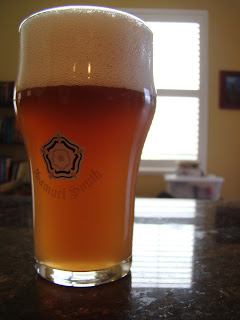 BRING IT ON DIPA
Appearance: (Chill) hazy golden orange color, big off-white head that has a good bit of staying power. In pouring, the beer/bottle yeast can have a strange pinkish hue. Becomes very clear when warm.
Smell: Pine, onion, some alcohol, a little bread as it warms.
Taste: Pine & onion hanging around from the aroma along with some diesel hop character. Some perception of sweetness that may be coming from the hops. Finishes with a balanced bitterness, definitely not overly bitter.
Mouthfeel: On the thin side, though not overly so. Medium carbonation; hits the tongue without filleting it. A little tongue numbing.
Overall: Probably my most successful attempt at a double IPA. This one reached the degree of attenuation I was seeking to get away from cloying malt sweetness; I may even want to bump it back up a couple points next time to retain a bit more malt backbone. Malt definitely didn't get in the way here, and I'm tempted to add in a higher percentage of character grains (Munich, Vienna, aromatic, or even a bit of crystal) in the future. I'm slowly coming to grips with the fact that the Amarillo hops I've had in the last couple years do not have the same citrus characteristics that endeared this varietal to me originally. I'm getting a lot more of the onion/garlic/diesel now. It doesn't always come out--and I sure hope it doesn't on the session IPA I'm brewing today--but I'm missing the mark more often than not with this hop.
=====
 Winter Porter
Appearance: Deep brown/black body with clear red-brown highlights; a little bit of light brown foam hangs out at the rim for a while. While I'd like more head on this beer, otherwise it looks pretty much like spot on for the style.
Smell: I've given this one fifteen to twenty minutes to warm up before sampling, so much of the diacetyl present in this batch--which has been widely variable, bottle to bottle--may have blown off. Some butter popcorn remains, combining with the dark grains and a mineral character to give an impression of sharp mineral roastiness. While not terrible, the diacetyl buttery character has been so strong on other bottles as to make this nigh undrinkable.
Taste: I'm struggling here. Not assertively roasty, though not chocolatey either. Has a certain tang that I associate with the dark malts to a degree, but I can't quite pin with a descriptor. Not the best.
Mouthfeel: Medium-full body from the residual sweetness and slight residual diacetyl. Does retain a certain creaminess, especially when chewed a bit. Not unpleasant.
Overall: Not my favorite porter, to be sure. I've had spectacular results from this yeast (WY1469) in the past, but on this batch it really took a bad turn. This was my first real experience with diacetyl, and it's been strong enough to encourage me to do a diacetyl rest on every beer from here on out. It's been a few years now since I had Flag Porter, but my recollection of that beer was my guide here. My quest for a really badass "English/brown" porter continues.
=====
 BRING IT ON DIPA
Appearance: (Chill) hazy golden orange color, big off-white head that has a good bit of staying power. In pouring, the beer/bottle yeast can have a strange pinkish hue. Becomes very clear when warm.
Smell: Pine, onion, some alcohol, a little bread as it warms.
Taste: Pine & onion hanging around from the aroma along with some diesel hop character. Some perception of sweetness that may be coming from the hops. Finishes with a balanced bitterness, definitely not overly bitter.
Mouthfeel: On the thin side, though not overly so. Medium carbonation; hits the tongue without filleting it. A little tongue numbing.
Overall: Probably my most successful attempt at a double IPA. This one reached the degree of attenuation I was seeking to get away from cloying malt sweetness; I may even want to bump it back up a couple points next time to retain a bit more malt backbone. Malt definitely didn't get in the way here, and I'm tempted to add in a higher percentage of character grains (Munich, Vienna, aromatic, or even a bit of crystal) in the future. I'm slowly coming to grips with the fact that the Amarillo hops I've had in the last couple years do not have the same citrus characteristics that endeared this varietal to me originally. I'm getting a lot more of the onion/garlic/diesel now. It doesn't always come out--and I sure hope it doesn't on the session IPA I'm brewing today--but I'm missing the mark more often than not with this hop.
=====

Appearance: Deep brown/black body with clear red-brown highlights; a little bit of light brown foam hangs out at the rim for a while. While I'd like more head on this beer, otherwise it looks pretty much like spot on for the style.
Smell: I've given this one fifteen to twenty minutes to warm up before sampling, so much of the diacetyl present in this batch--which has been widely variable, bottle to bottle--may have blown off. Some butter popcorn remains, combining with the dark grains and a mineral character to give an impression of sharp mineral roastiness. While not terrible, the diacetyl buttery character has been so strong on other bottles as to make this nigh undrinkable.
Taste: I'm struggling here. Not assertively roasty, though not chocolatey either. Has a certain tang that I associate with the dark malts to a degree, but I can't quite pin with a descriptor. Not the best.
Mouthfeel: Medium-full body from the residual sweetness and slight residual diacetyl. Does retain a certain creaminess, especially when chewed a bit. Not unpleasant.
Overall: Not my favorite porter, to be sure. I've had spectacular results from this yeast (WY1469) in the past, but on this batch it really took a bad turn. This was my first real experience with diacetyl, and it's been strong enough to encourage me to do a diacetyl rest on every beer from here on out. It's been a few years now since I had Flag Porter, but my recollection of that beer was my guide here. My quest for a really badass "English/brown" porter continues.
Saturday, May 7, 2016
Winter Porter

The beer came together without incident, but the yeast behaved differently than I expected. My experience with West Yorkshire Ale is that the kraeusen hangs around long after active fermentation ceases. This time around, I saw almost no visible activity other than a bit of trub ring. Though this batch had plenty of time to sit at room temp at the end of fermentation, this batch showed lots of diacetyl shortly after bottling. Fortunately, a lot of that has seemed to dissipate over time. The resulting beer is pleasant, though it has an edge that I attribute to too much roast malt. I kept pushing up the roasted grains in BeerSmith to get it dark enough; the end result is plenty brown-black, but could probably do with a reduction in these malts to keep it from getting to acrid. The remaining diacetyl works with the acrid roast character in a not unpleasant way, resulting in a bit of dark fruit character rounding out the flavor. Not bad; would rebrew with tweaks.
Winter Porter
Batch size: 5.5 gallons
Projected OG: 1.045
Projected SRM: 29.1
Projected IBU: 27.9
Boil time: 70 minutes
Brewhouse efficiency: 66%
Grains/Fermentables
67.5% - 7 lb Rahr 2-row
14.5% - 1.5 lb Brown malt
9.6% - 1 lb UK dark crystal (75-80L)
4.8% - 8 oz UK Pale Chocolate
3.6% - 6 oz UK Chocolate
Hops

1.3 oz EKG (5.7%) (10 min)
.3 oz Styrian Goldings (3.8%) (10 min)
Yeast
WY1469 West Yorkshire Ale - no starter
Extras
1 tsp Yeast nutrient (5 min)
Water (mash)
Base Profile: Reno (brewersfriend.com)
107 Ca, 11.2 Mg, 44.1 Na, 63.7 SO4
Alkalinity 171.6, RA 88.7
Brewday: 10 February 2016
Mash: 13 qts @ 154F for 60 minutes + 2 qts @ 212F to get to temp
1st sparge: 12 qts @ 190F
2nd sparge: 13 qts @ 180F
Pre-boil volume: gallons
Pre-boil SG: 10P (1.0)
Salt additions (to mash): 1 g Gypsum, 3 g Epsom salt, 4 g CaCl, 11 g Chalk, 5 g Baking Soda, 8 ml Lactic Acid (88%)
5.8 gallons at 64F to the fermenter; no aeration past transfer splashing.
Fermented in swamp cooler at 65F ambient.
13 February 2016: Visible activity stopped without any sign of the never-ending krauesen characteristic of this yeast. Removed from swamp cooler & agitated; sat at ambient (68F). Moderate surface bubbling—not a real krauesen yet—appeared over the course of the day.
Bottled: 2 March 2016
FG: 1.018
ABV: 3.5%
Bottled with 3.4 oz table sugar.
Moved final gallon onto Sour Culture No. 2.
Sour Bottled: 30 April 2016
FG: 1.013
ABV: 4.2%
Good lactic sourness.
Bottled with .3 oz table sugar.
Tasting
Monday, June 22, 2015
Quick Summer Saison

This beer distinctly departs from my recently successful rye saison. With under two weeks to go from kettle to bottle, I aimed to produce a table-strength beer that started in the neighborhood of 1.040. Looking for a little more malt
 complexity, I split the base malt between Vienna and dark Munich, including moderate amounts of malted rye and oats. Not needing the gravity boost and mashing low to reach proper dryness, I skipped the sugar on this one. While
I dig the ease of use and results from a good pitch of WY3711, Ted's saison reminded me that I've wanted to get back to WLP566, which worked so well in my spiced petite saison noire a few years ago (and which I'll finally rebrew this fall, hopefully).
complexity, I split the base malt between Vienna and dark Munich, including moderate amounts of malted rye and oats. Not needing the gravity boost and mashing low to reach proper dryness, I skipped the sugar on this one. While
I dig the ease of use and results from a good pitch of WY3711, Ted's saison reminded me that I've wanted to get back to WLP566, which worked so well in my spiced petite saison noire a few years ago (and which I'll finally rebrew this fall, hopefully).Fermentation happened even faster than I'd planned, so much so that I didn't really get to ramp up the primary temperature very much before the krauesen dropped. Final gravity was a touch higher than I'd like but not out of bounds, and consistent with my other results with this yeast; since I moved it to bottles so quickly, I just hope it was really finished! I'm keeping an eye on the batch, and the bottles have behaved themselves so far. Happy to have a little variety in my summer supplies, especially as I travel.
Peu Été
Batch size: 4.5 gallons
Projected OG: 1.040
Projected SRM: 5.9
Projected IBU: 22.9
Boil time: 60 minutes
Brewhouse efficiency: 78%
Grains
43.5% - 3 lb Best Malz Vienna
29.0% - 2 lb Weyermann Dark Munich
14.5% - 1 lb Weyermann Rye
13.0% - .9 lb Organic flaked oats
Hops
.2 oz Millennium (15.9%) (60 min)
2 oz St. Celeia (Styrian) Goldings (4.5%) (5 min)
Yeast
WLP566 Saison II - no starter
Extras
1 tsp Yeast nutrient (5 min)
1 tsp Irish moss (5 min)

Profile: Reno
1 g Gypsum
2 g (3 g) Epsom salts
5 g CaCl
2 mL Lactic Acid (88%)
Brewday: 11 June 2015
Mash: 120 minutes - dropped to 129F
Pre-boil volume: 6.5 gallons
Pre-boil SG: 8.1P (1.032)
Water report and chemical calculations from brewersfriend.com, using "light colored & malty" setting.
Began fermentation in water bath at 69-71F (beer temp) for first 2 days. Krauesen dropped on day 2; beer temp 72F. Removed from water bath to reach ambient temp (75-80F) until bottling, yeast roused regularly for the first few days.
Bottled: 19 June 2015
FG: 1.009
ABV: 4.1%
Bottled with 4.9 oz table sugar.
Early tasting: 3 July 2015
It's only had two weeks in the bottle, but so far this reads much more like a Belgian pale ale: the fruity & peppery notes are much more muted than I'd expect from a saison, accompanied by a huge, warm bready character that develops as it warms. No overcarbonation/bottle bombs so far.
Monday, March 9, 2015
Session IPA II

While I'm still fond of beers with significant percentages of rye in the grist, it's high time I reached the end of the sack of Weyermann rye malt I've been working through. So on this batch, Vienna was out and rye was in. All other variables remained the same: the grist (including the base malt percentage), the hopping, the yeast (though it was a repitch of the washed cake from the first batch), and the fermentation conditions.
My past with rye has been sortid, and the runnings were predictably slow to emerge from the mash. I ended up heating the first runnings and adding it back as well as adding wetted rice hulls and giving it several hours to run off. I added a small amount of sparge water when the kettle volume came in low...which ended up pulling out the missing wort and giving me a higher than intended boil volume. The OG came in a bit higher than the first batch because of it.

While this batch wasn't sweet, the rye is overwhelming; despite the low ABV, it's difficult to consume more than a glass at a time. I find the session IPA concept as a whole to be very sound, though: keep it malty by using characterful grains, mashing high, and not sparging; go with big late hopping; and use a yeast with a lot of its own character. This definitely fulfills a hop jones without nailing the drinker with an overabundance of alcohol. I suspect there will be more of this around as the weather continues to warm.
Session IPA II - The Rye (also posted at Brewtoad)
Batch size: 5 gallons
Projected OG: 1.043
Projected SRM: 8
Projected IBU: 43
Boil time: 60 minutes
Brewhouse efficiency: 71%
Grains
83.3% - 7.5 lb Weyermann Rye malt
11.1% - 1 lb Flaked oats
5.6% - .5 lb Belgian Caramunich 80L
Hops
2.0 oz Amarillo (10.7%) (10 min)
.5 oz Columbus (15.6%) (10 min)
.5 oz Centennial (11.3%) (10 min)
1.0 oz Amarillo (0 min) 30-min steep
.5 oz Columbus (0 min) 30-min steep
.5 oz Centennial (0 min) 30-min steep
.5 oz Centennial (Dry hop - 5 days) - Cask #2
.5 oz Amarillo (Dry hop - 5 days) - Cask #3
 Yeast
Yeast
Wyeast WY1469 West Yorkshire Ale - no starter
Water
Profile: Reno
9 g Gypsum
3 g CaCl
2 ml Lactic acid (88%)
Brewday: 15 February 2015
Mash: 154F for 60 minutes
No sparge (mostly) - added 5 qts @ 212F to get out
Pre-boil volume: 7.8 gallons
Pre-boil SG: 9.7P (1.039)
Runoff was sticky; lautered about 2/3 before it stuck hard. Heated runnings to 185F & added back to mash tun. Also tried blowing out hose & adding two wetted handfuls of rice hulls.
Fermenter volume: 5.4 gallons
Fermented at 64-66F, raised to 70F near the end of fermentation.
.5 oz Columbus (15.6%) (10 min)
.5 oz Centennial (11.3%) (10 min)
1.0 oz Amarillo (0 min) 30-min steep
.5 oz Columbus (0 min) 30-min steep
.5 oz Centennial (0 min) 30-min steep
.5 oz Centennial (Dry hop - 5 days) - Cask #2
.5 oz Amarillo (Dry hop - 5 days) - Cask #3
Wyeast WY1469 West Yorkshire Ale - no starter
Water
Profile: Reno
9 g Gypsum
3 g CaCl
2 ml Lactic acid (88%)
Brewday: 15 February 2015
Mash: 154F for 60 minutes
No sparge (mostly) - added 5 qts @ 212F to get out
Pre-boil volume: 7.8 gallons
Pre-boil SG: 9.7P (1.039)
Runoff was sticky; lautered about 2/3 before it stuck hard. Heated runnings to 185F & added back to mash tun. Also tried blowing out hose & adding two wetted handfuls of rice hulls.
Fermenter volume: 5.4 gallons
Fermented at 64-66F, raised to 70F near the end of fermentation.
Bottled: 28 February 2015
FG: 1.020!
ABV: 3.0%
Bottled with 2.1 oz table sugar. 3 gallons went into cubitainers: one plain, one with .5 oz Amarillo, one with .5 oz Centennial.
Sunday, March 1, 2015
Session IPA
 While I was still under the impression that my two recent saisons hadn't turned out (which more recent taste tests have proven false), I really wanted to make something quick and straight ahead (i.e.,
 The Mad Fermentationist provided invaluable assistance, as always. Fortunately I still had just enough Vienna malt in the house for most of the grist, complemented with oats and Belgian Caramunich for enhanced mouthfeel, residual sugar, and further depth of flavor. I also went with my first no-sparge mash to increase body and malt perception. In addition, Wyeast's West Yorkshire Ale yeast provided extra character and low attenuation to round out the package. To keep things extra international, the hops were all American, plentiful, and were hopbursted, hop stand-ed, and dry hopped.

I pulled around a half gallon for cask conditioning in a cubitainer when the rest of the batch went to secondary for dry hopping. The "cask" was really fantastic; great aroma, super fruity and balanced. It seems like some of that dropped off in the secondary, possibly because of the size of the dry hop charge. The main batch is drinking just fine, however; I have no complaints about a lack of good beer in the house ready to go. I've already rebrewed this recipe with a couple tweaks, one major, one minor; more on that soon. For now, though, things are tasting great.
Session IPA (also available at Brewtoad)
Batch size: 5 gallons
Projected OG: 1.039
Projected SRM: 9
Projected IBU: 49
Boil time: 60 minutes
Brewhouse efficiency: 59%
Grains
83.3% - 7.5 lb Weyermann Organic Vienna
11.1% - 1 lb Flaked oats
5.6% - .5 lb Belgian Caramunich 80L

2 oz Amarillo (10.7%) (10 min)
.5 oz Columbus (15.6%) (10 min)
.5 oz Centennial (11.3%) (10 min)
1 oz Amarillo (0 min) 30-min steep
.5 oz Columbus (0 min) 30-min steep
.5 oz Centennial (0 min) 30-min steep
3 oz Amarillo (Dry hop - 6 days)
1 oz Columbus (Dry hop - 6 days)
1 oz Centennial (Dry hop - 6 days)
Yeast
Wyeast WY1469 West Yorkshire Ale - no starter
Water
Profile: Reno
9 g Gypsum
3 g CaCl
2 ml Lactic acid (88%)
Brewday: 17 January 2015
Mash: 154F for 60 minutes
No sparge
Pre-boil volume: 7.5 gallons
Pre-boil SG: 8.5P (1.034)
Amarillo additions should have been 1 oz @ 10 min, 2 oz for hop stand.
Water report and chemical calculations from brewersfriend.com, using "light colored & hoppy" setting.
Fermenter volume: 5.8 gallons
Fermented at 64F, raised to 67F near the end of fermentation.
Secondary: 26 January 2015
Put some air into the beer when I had to restart the siphon mid-transfer. Extra ~1/2 gallon went into a 1-gallon cubitainer with .4 oz table sugar.
Bottled: 1 February 2015
FG: 1.013
ABV: 3.4%
Bottled with 2.2 oz table sugar.
Honorable Mention: Great Basin Brew-Off 2015 (Pale & Amber Ales)
Subscribe to:
Posts (Atom)