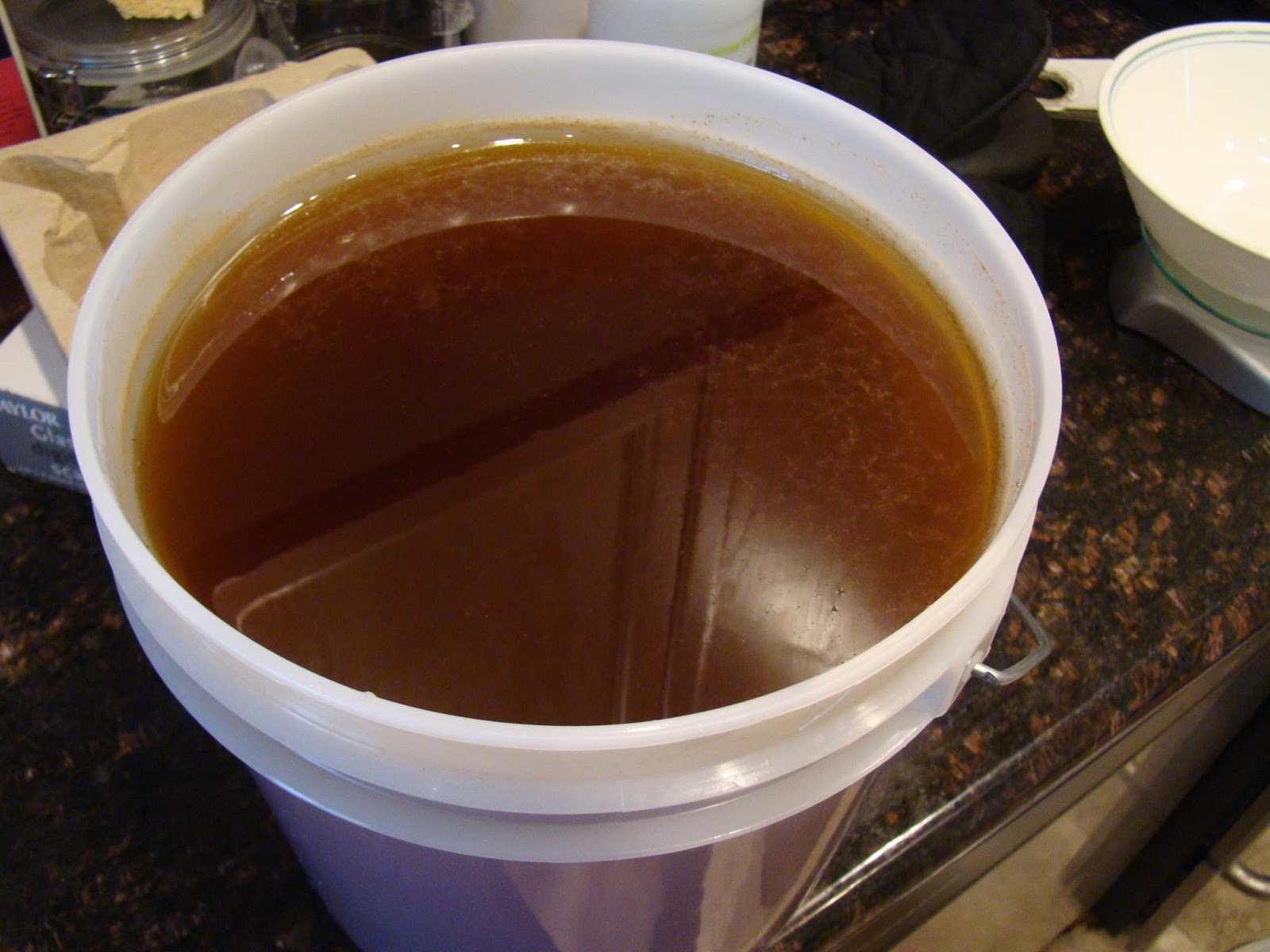
While my wife can't drink beer and wasn't into IPAs even when she still did, she quite likes a hopped cider or mead. Before leaving town this summer, I started a batch of mead to scratch that itch.
The ingredients were, as usual for mead, pretty simple: the remainder of the 24-lb bucket of great Utah honey we purchased last year. I used the TOSNA regimen suggested by Sergio Moutela, owner of Melovino Meadery, on Mead Made Right. I wanted principally fruity hops to go with the floral character of the honey, so opted for Centennial and Mosaic.
The batch came together quickly and easily, but I didn't really see the kind of initial activity I thought I remembered from previous batches of mead. Dummy that I am, I just started hitting it with more yeast and oxygen. It took my local homebrew shop owners encouraging me not to just judge it on appearance for me to actually check the gravity. Indeed, it was fermenting just fine, so I started with the nutrients schedule a few days late and with a bunch of extra oxygen and yeast in the batch. Thankfully, it doesn't seem to have had an adverse effect on the final product.
When we returned from our travels in August, the batch had settled into semi-sweet territory, which suited us just fine. Past batches that have fermented out further have struck me as overly thin and slightly medicinal; this one was fuller, rounder, and still retained a good sense of the honey. The dry hops added a juicy tropical fruit and citrus character that melded well with the honey. This is one of my most successful mead batches, despite some early hiccups in process and judgement. I'll be interested to see how the hop character continues to change and fade into the background as this ages.
Hopped Mead
Batch size: 5 gallons
Projected OG: 1.100
Fermentables
13 lb Utah mountain honey
Hops
2 oz Centennial (7.6%) (Dry hop - 3 days)
2 oz Mosaic (11.3%) (Dry hop - 3 days)
Yeast
5 g Lalvin 71B-1122 (rehydrated)
Extras
6.25 g Go-Ferm (yeast rehydration)
25 g Fermaid-O (TOSNA: 6.25 g @ 24, 48, 72 hrs, 7 days after pitching)
Brewed: 31 May 2016
Rehydrate yeast: 125 g boiled water
OG: 24.2P
Boiled water, used some at 160F to liquefy honey. Cooled rest to 68F, filled to 5.5-gallon mark, pitched yeast, put in swamp cooler with 56F water to chill to ferment temp. Swapped out water once & added ice packs to continue chilling.
Fermented in swamp cooler at 62-64F ambient.
3 June 2016: No activity yet. Repeated rehydration with new yeast & Go-Ferm as well as 60 seconds of O2.
7 June 2016: Took a lack of visible activity to mean that the yeast were not working. Took hydrometer reading today: down to 1.085, so some activity is taking place. Initiating TOSNA schedule starting today.
Degassed twice a day for the first week of fermentation.
After the first week, left town for a few days; swamp cooler ambient reached 69F. Upon returning, cooled it back down into 62-64F range and degassed about once a day for the remainder of primary.
14 June 2016: Final Fermaid-O addition.
18 June 2016: Moved out of swamp cooler to sit at ambient (~75F) for the next month and a half. Have continued to degas twice daily up until now.
Secondary: 05 September 2016
FG: 1.012
ABV: 11.7%
Tastes pretty damn good! Residual sugar keeps it from coming across with a lot of cardboard, phenolics, or watery character.
Added 2.5 tsp bentonite dissolved in 1 cups boiled water, held 10 hours.
Dry hopped: 18 September 2016
Bottled: 21 September 2016
Sample had a little more tropical fruit hop flavor, but not a lot of hop aroma.
Saturday, October 8, 2016
Wednesday, September 14, 2016
Session IPA III Tasting
Back from summer travels, it's time to get down to business. Let's start with some long overdue tasting notes. This batch is in its twilight: we're down to the last few bottles, and it's past its peak. I was worried that the final bit had turned entirely for the worst, but the bottle I used for this tasting was still hanging in there.
Appearance: Brilliantly clear gold-orange. Foam hangs around well.
Smell: Floral, red berry and orange, a little caramel. Round and sweet.
Taste: Hops are fading, but good grapefruit and orange notes still come through, along with a touch of dank. Crisp bitterness, warm wheat bread finish.
Mouthfeel: Nice medium body that, consistent from start to finish.
Overall: This was a nice quencher over the summer; it went over well with the folks who tried it as well as with me. Though it’s past its prime now, it’s still drinking well.
Appearance: Brilliantly clear gold-orange. Foam hangs around well.
Smell: Floral, red berry and orange, a little caramel. Round and sweet.
Taste: Hops are fading, but good grapefruit and orange notes still come through, along with a touch of dank. Crisp bitterness, warm wheat bread finish.
Mouthfeel: Nice medium body that, consistent from start to finish.
Overall: This was a nice quencher over the summer; it went over well with the folks who tried it as well as with me. Though it’s past its prime now, it’s still drinking well.
Friday, July 22, 2016
Dark Mild Tasting
Happy to get to tasting notes on this beer, which I've been enjoying all summer. I still haven't really connected with this style; it strikes me as somewhere between a blonde ale (light, not overtly hoppy, easy drinking) and an English brown (rich "fruity" English yeast character, chocolate & toffee from roasted & caramel malts). This batch has been much more drinkable than past attempts. My most recent session IPA has been more of a go-to of late, but it's been nice to switch it up regularly by going to the "dark side."
Appearance: Deep brown, ruby highlights when held to the light. The latte-like head lingers for most of the session.
Smell: Toffee dominates, followed by a little burnt caramel.
Taste: Toffee, milk chocolate, hint of coffee, a little peach, a whiff of alcohol on the end. No hops of which to speak.
Mouthfeel: Round, surprisingly full for such a low-gravity beer. A little tickle of carbonation keeps it from overstaying its welcome.
Overall: Though it still strikes me as an odd duck--I haven't tried too many examples to "normalize" my palate to it--it's a solid little fighter. I'm encouraged to keep exploring this style in the future.
Appearance: Deep brown, ruby highlights when held to the light. The latte-like head lingers for most of the session.
Smell: Toffee dominates, followed by a little burnt caramel.
Taste: Toffee, milk chocolate, hint of coffee, a little peach, a whiff of alcohol on the end. No hops of which to speak.
Mouthfeel: Round, surprisingly full for such a low-gravity beer. A little tickle of carbonation keeps it from overstaying its welcome.
Overall: Though it still strikes me as an odd duck--I haven't tried too many examples to "normalize" my palate to it--it's a solid little fighter. I'm encouraged to keep exploring this style in the future.
Wednesday, June 1, 2016
Session IPA III
As with the dark mild, I started this batch as a semi-open fermentation, letting it do its first few days of active fermenting with the bucket lid loose and aluminum foil instead of an airlock. The aromas coming from the fermenter have been encouragingly fruity. If it ends up like its predecessors, it won't be hard to enjoy. Bring on the heat of summer.
Session IPA III
Batch size: 5.5 gallons
Projected OG: 1.038
Projected SRM: 6.8
Projected IBU: 57.3
Boil time: 60 minutes
Brewhouse efficiency: 67%
Grains
83.3% - 7.5 lb Weyermann Organic Vienna
11.1% - 1 lb Flaked oats
5.6% - .5 lb Belgian Caramunich 80L
Hops
.5 oz Amarillo (10.7%) (10 min)
.5 oz Columbus (15.2%) (10 min)
1 oz Simcoe (12.9%) (0 min) 40-min steep
1 oz Amarillo (0 min) 40-min steep
.5 oz Columbus (0 min) 40-min steep
2 oz Amarillo (dry hop - 6 days)
1 oz Simcoe (dry hop - 6 days)
Yeast
WY1469 West Yorkshire Ale - 3rd generation, harvested from Dark Mild
Extras
1 tsp Yeast nutrient (5 min)
.5 tablet Whirlfloc (5 min)
Water (mash)
Profile: Reno (brewersfriend.com)
Target profile: Light colored and hoppy (brewersfriend.com)
94.5 Ca, 3 Mg, 10 Na, 48.5 Cl, 150.4 SO4
Alkalinity 8.3, RA -60.8
Brewday: 24 May 2016
Mash: 154F for 60 minutes
No sparge
Pre-boil volume: 7.5 gallons
Pre-boil SG: 8.3P (1.032)
Water additions (mash): 9 g Gypsum, 3 g CaCl, 2 ml Lactic acid (88%).
5.75 gallons to fermenter at 66F. Fermented in swamp cooler at 64F. Started with fermenter lid loose for semi-open fermentation.
27 May 2016: Sealed fermenter, added airlock, and removed temp control; rose to 70F over the next few days. Agitated (spun fermenter) 2-3 times/day.
31 May 2016: Removed fermenter from swamp cooler; ambient ~75F.
Bottled: 9 June 2016
Forgot to check FG!
Bottled 4.5 gallons with 3.6 oz table sugar.
Dark Mild
Looking to have some sessionable beers on hand for the summer, I returned to the realm of British ales. Milds have rarely crossed my path, but I find the concept of a dark, low-alcohol beer that pushes malt and a little roast over hops intriguing. Having recently started listening to the Experimental Brewing podcast, and mild having come up there in light of the recent Session Beer Day, this recipe is loosely based on host Drew Beechum's (et al.) CDJK Mild.
I grew up the West Yorkshire Ale yeast from my sadly diacetyl-laden porter, hoping that getting past that first generation might yield better results. Thankfully it did: I've noticed no diacetyl so far. I also skipped water treatment (except carbon filtering) this time. As I continue to refine my brewing practices, it seemed a good idea to see what kind of beer my source water produces on its own before monkeying with the chemistry, which I still don't fully grasp (it's been slow going through Water for some time now). I'll pick on this aspect if/when I rebrew this recipe.
As this style traditionally gets the cask treatment, my three one-gallon cubitainers came back out on bottling day. Not having any interesting aroma hops around at the time--and this being a more malt-focused style anyway--experimentation between vessels took a different turn. One cubitainer remained plain, one got home-toasted oak cubes, and the last got a small dose of whole Stumptown coffee beans from our recent trip to Portland. I sampled liberally from all three in celebration of Memorial Day; while all were quite good, the oaked version really stood out for me. Full tasting notes coming soon!
Dark Mild
Batch size: 5.5 gallons
Projected OG: 1.040
Projected SRM: 19.1
Projected IBU: 22.3
Boil time: 60 minutes
Brewhouse efficiency: 64%
Grains/Fermentables
60.6% - 5 lb Rahr 2-row
12.1% - 1 lb Bairds Crystal 75L
3.0% - 4 oz Bairds RB
12.1% - 1 lb Flaked oats
12.1% - 1 lb Turbinado
Hops
1 oz EKG (5.7%) (60 min)
Yeast
WY1469 West Yorkshire Ale - 1L starter from Winter Porter yeast cake
Extras
1 tsp Yeast nutrient (5 min)
.5 tablet Whirlfloc (5 min)
Water (mash)
Profile: Reno (brewersfriend.com)
Brewday: 7 May 2016
Mash: 153F for 60 minutes
Pre-boil volume: 7.5 gallons
Pre-boil SG (w/o sugar): 6.9P (1.027)
Fermented in bucket with lid loose in swamp cooler at 65F ambient; locked down lid, affixed airlock, and ramped up to 68F after 3 days active fermentation.
Bottled: 23 May 2016
FG: 1.010
ABV: 3.9%
3 gallons into cubitainers, each with .2 oz table sugar: 1 plain, 1 with g oak cubes (boiled), 1 with 3 g Stumptown El Nevado Colombian coffee beans (whole, loose, unsanitized).
Remainder bottled with 1.66 oz table sugar.
I grew up the West Yorkshire Ale yeast from my sadly diacetyl-laden porter, hoping that getting past that first generation might yield better results. Thankfully it did: I've noticed no diacetyl so far. I also skipped water treatment (except carbon filtering) this time. As I continue to refine my brewing practices, it seemed a good idea to see what kind of beer my source water produces on its own before monkeying with the chemistry, which I still don't fully grasp (it's been slow going through Water for some time now). I'll pick on this aspect if/when I rebrew this recipe.
As this style traditionally gets the cask treatment, my three one-gallon cubitainers came back out on bottling day. Not having any interesting aroma hops around at the time--and this being a more malt-focused style anyway--experimentation between vessels took a different turn. One cubitainer remained plain, one got home-toasted oak cubes, and the last got a small dose of whole Stumptown coffee beans from our recent trip to Portland. I sampled liberally from all three in celebration of Memorial Day; while all were quite good, the oaked version really stood out for me. Full tasting notes coming soon!
Dark Mild
Batch size: 5.5 gallons
Projected OG: 1.040
Projected SRM: 19.1
Projected IBU: 22.3
Boil time: 60 minutes
Brewhouse efficiency: 64%
Grains/Fermentables
60.6% - 5 lb Rahr 2-row
12.1% - 1 lb Bairds Crystal 75L
3.0% - 4 oz Bairds RB
12.1% - 1 lb Flaked oats
12.1% - 1 lb Turbinado
Hops
1 oz EKG (5.7%) (60 min)
Yeast
WY1469 West Yorkshire Ale - 1L starter from Winter Porter yeast cake
Extras
1 tsp Yeast nutrient (5 min)
.5 tablet Whirlfloc (5 min)
Water (mash)
Profile: Reno (brewersfriend.com)
Brewday: 7 May 2016
Mash: 153F for 60 minutes
Pre-boil volume: 7.5 gallons
Pre-boil SG (w/o sugar): 6.9P (1.027)
Bottled: 23 May 2016
FG: 1.010
ABV: 3.9%
3 gallons into cubitainers, each with .2 oz table sugar: 1 plain, 1 with g oak cubes (boiled), 1 with 3 g Stumptown El Nevado Colombian coffee beans (whole, loose, unsanitized).
Remainder bottled with 1.66 oz table sugar.
Tuesday, May 24, 2016
Double IPA & Winter Porter Tasting
While brewing a session IPA today to have on hand for summer festivities, I finally decided to knock out a couple sets of tasting notes. Neither of these beers turned out exactly as I'd like. The double IPA seems like it might've found the mark if I wouldn't cling so closely to my memory of what Amarillo hops used to be; the porter suffered from my own misuse or mistreatment of the West Yorkshire Ale yeast. For all the smack I talk below, I'm still drinking both these beers without having to work too hard to choke them down.
=====
BRING IT ON DIPA
Appearance: (Chill) hazy golden orange color, big off-white head that has a good bit of staying power. In pouring, the beer/bottle yeast can have a strange pinkish hue. Becomes very clear when warm.
Smell: Pine, onion, some alcohol, a little bread as it warms.
Taste: Pine & onion hanging around from the aroma along with some diesel hop character. Some perception of sweetness that may be coming from the hops. Finishes with a balanced bitterness, definitely not overly bitter.
Mouthfeel: On the thin side, though not overly so. Medium carbonation; hits the tongue without filleting it. A little tongue numbing.
Overall: Probably my most successful attempt at a double IPA. This one reached the degree of attenuation I was seeking to get away from cloying malt sweetness; I may even want to bump it back up a couple points next time to retain a bit more malt backbone. Malt definitely didn't get in the way here, and I'm tempted to add in a higher percentage of character grains (Munich, Vienna, aromatic, or even a bit of crystal) in the future. I'm slowly coming to grips with the fact that the Amarillo hops I've had in the last couple years do not have the same citrus characteristics that endeared this varietal to me originally. I'm getting a lot more of the onion/garlic/diesel now. It doesn't always come out--and I sure hope it doesn't on the session IPA I'm brewing today--but I'm missing the mark more often than not with this hop.
=====
Winter Porter
Appearance: Deep brown/black body with clear red-brown highlights; a little bit of light brown foam hangs out at the rim for a while. While I'd like more head on this beer, otherwise it looks pretty much like spot on for the style.
Smell: I've given this one fifteen to twenty minutes to warm up before sampling, so much of the diacetyl present in this batch--which has been widely variable, bottle to bottle--may have blown off. Some butter popcorn remains, combining with the dark grains and a mineral character to give an impression of sharp mineral roastiness. While not terrible, the diacetyl buttery character has been so strong on other bottles as to make this nigh undrinkable.
Taste: I'm struggling here. Not assertively roasty, though not chocolatey either. Has a certain tang that I associate with the dark malts to a degree, but I can't quite pin with a descriptor. Not the best.
Mouthfeel: Medium-full body from the residual sweetness and slight residual diacetyl. Does retain a certain creaminess, especially when chewed a bit. Not unpleasant.
Overall: Not my favorite porter, to be sure. I've had spectacular results from this yeast (WY1469) in the past, but on this batch it really took a bad turn. This was my first real experience with diacetyl, and it's been strong enough to encourage me to do a diacetyl rest on every beer from here on out. It's been a few years now since I had Flag Porter, but my recollection of that beer was my guide here. My quest for a really badass "English/brown" porter continues.
=====
Appearance: (Chill) hazy golden orange color, big off-white head that has a good bit of staying power. In pouring, the beer/bottle yeast can have a strange pinkish hue. Becomes very clear when warm.
Smell: Pine, onion, some alcohol, a little bread as it warms.
Taste: Pine & onion hanging around from the aroma along with some diesel hop character. Some perception of sweetness that may be coming from the hops. Finishes with a balanced bitterness, definitely not overly bitter.
Mouthfeel: On the thin side, though not overly so. Medium carbonation; hits the tongue without filleting it. A little tongue numbing.
Overall: Probably my most successful attempt at a double IPA. This one reached the degree of attenuation I was seeking to get away from cloying malt sweetness; I may even want to bump it back up a couple points next time to retain a bit more malt backbone. Malt definitely didn't get in the way here, and I'm tempted to add in a higher percentage of character grains (Munich, Vienna, aromatic, or even a bit of crystal) in the future. I'm slowly coming to grips with the fact that the Amarillo hops I've had in the last couple years do not have the same citrus characteristics that endeared this varietal to me originally. I'm getting a lot more of the onion/garlic/diesel now. It doesn't always come out--and I sure hope it doesn't on the session IPA I'm brewing today--but I'm missing the mark more often than not with this hop.
=====
Winter Porter
Appearance: Deep brown/black body with clear red-brown highlights; a little bit of light brown foam hangs out at the rim for a while. While I'd like more head on this beer, otherwise it looks pretty much like spot on for the style.
Smell: I've given this one fifteen to twenty minutes to warm up before sampling, so much of the diacetyl present in this batch--which has been widely variable, bottle to bottle--may have blown off. Some butter popcorn remains, combining with the dark grains and a mineral character to give an impression of sharp mineral roastiness. While not terrible, the diacetyl buttery character has been so strong on other bottles as to make this nigh undrinkable.
Taste: I'm struggling here. Not assertively roasty, though not chocolatey either. Has a certain tang that I associate with the dark malts to a degree, but I can't quite pin with a descriptor. Not the best.
Mouthfeel: Medium-full body from the residual sweetness and slight residual diacetyl. Does retain a certain creaminess, especially when chewed a bit. Not unpleasant.
Overall: Not my favorite porter, to be sure. I've had spectacular results from this yeast (WY1469) in the past, but on this batch it really took a bad turn. This was my first real experience with diacetyl, and it's been strong enough to encourage me to do a diacetyl rest on every beer from here on out. It's been a few years now since I had Flag Porter, but my recollection of that beer was my guide here. My quest for a really badass "English/brown" porter continues.
Sunday, May 22, 2016
Peach Melomel III
Last summer in northern Utah, I picked up a 24-lb bucket of local wildflower honey to bump up mead production for DeAunn. When we returned to Reno, we also bought several pounds of fruit at the local farmers' markets for various fermentation projects, which we prepared and socked away in the freezer. It took me until earlier this month to finally do something with all of it.
While she's been very receptive to all of my mead making endeavors, DeAunn has always particularly loved my peach melomel. Having only six pounds of peaches to dedicate to the cause, I aimed for a three-gallon batch. Fermenting in a full-size carboy or bucket sure beat working with the little two-gallon bucket or one-gallon wine jugs I've used before.
Also new and exciting was using the TOSNA (tailored organic staggered nutrient addition) method as detailed by Sergio Moutela of Melovino Meader on Mead Made Right. I've followed the conventional SNA, as set forth by champion mead maker Curt Stock, for past batches and have been pleased with the outcome; I'll be curious to see how this batch might differ because of this altered method. Both methods champion relatively quick turnaround: two to three months to being drinkable versus a year or more that more traditional methods require.
Having just transferred to secondary, my only change for future batches right now would be to bag the fruit in primary. There was around four and a half gallons of material in the primary fermenter; from it, I couldn't quite squeeze out a full three gallons to transfer, leaving behind a massive amount of peach sludge. It will get close to a month in secondary before bottling so we can take plenty with us for our summer travels (and age the rest for the next year). Now to decide what to do with the rest of this bucket of honey...
Peach Melomel III
Batch size: 3 gallons
Projected OG: 1.100
Fermentables
10 lb Utah mountain honey
6 lb Peaches (peeled, frozen)
Yeast
4 g Lalvin 71B-1122 (rehydrated)
Extras
5 g Go-Ferm (yeast rehydration)
15 g Fermaid-O (TOSNA: 3.75 g @ 24, 48, 72 hrs, 7 days after pitching)
Brewed: 4 May 2016
Rehydrate yeast: 100 g boiled water
OG: 18.8P (1.0 - Figuring honey isn’t totally diluted, nor are the peaches
Fermented in swamp cooler at 62-64F. Degassed twice a day for the first week of fermentation.
After the first week, left town for a few days; swamp cooler ambient reached 69F. Upon returning, cooled it back down into 62-64F range and degassed about once a day for the remainder of primary.
Secondary: 22 May 2016
FG: 1.010
ABV: 13.7%
Added 1.5 tsp bentonite dissolved in 1.5 cups boiled water.
Incredible amount of peach sludge; struggled to extract nearly 3 gallons from 4.5-gallon primary.
Bottled: 9 June 2016
While she's been very receptive to all of my mead making endeavors, DeAunn has always particularly loved my peach melomel. Having only six pounds of peaches to dedicate to the cause, I aimed for a three-gallon batch. Fermenting in a full-size carboy or bucket sure beat working with the little two-gallon bucket or one-gallon wine jugs I've used before.
Also new and exciting was using the TOSNA (tailored organic staggered nutrient addition) method as detailed by Sergio Moutela of Melovino Meader on Mead Made Right. I've followed the conventional SNA, as set forth by champion mead maker Curt Stock, for past batches and have been pleased with the outcome; I'll be curious to see how this batch might differ because of this altered method. Both methods champion relatively quick turnaround: two to three months to being drinkable versus a year or more that more traditional methods require.
Having just transferred to secondary, my only change for future batches right now would be to bag the fruit in primary. There was around four and a half gallons of material in the primary fermenter; from it, I couldn't quite squeeze out a full three gallons to transfer, leaving behind a massive amount of peach sludge. It will get close to a month in secondary before bottling so we can take plenty with us for our summer travels (and age the rest for the next year). Now to decide what to do with the rest of this bucket of honey...
Peach Melomel III
Batch size: 3 gallons
Projected OG: 1.100
Fermentables
10 lb Utah mountain honey
6 lb Peaches (peeled, frozen)
Yeast
4 g Lalvin 71B-1122 (rehydrated)
Extras
5 g Go-Ferm (yeast rehydration)
15 g Fermaid-O (TOSNA: 3.75 g @ 24, 48, 72 hrs, 7 days after pitching)
Brewed: 4 May 2016
Rehydrate yeast: 100 g boiled water
OG: 18.8P (1.0 - Figuring honey isn’t totally diluted, nor are the peaches
Fermented in swamp cooler at 62-64F. Degassed twice a day for the first week of fermentation.
After the first week, left town for a few days; swamp cooler ambient reached 69F. Upon returning, cooled it back down into 62-64F range and degassed about once a day for the remainder of primary.
FG: 1.010
ABV: 13.7%
Added 1.5 tsp bentonite dissolved in 1.5 cups boiled water.
Incredible amount of peach sludge; struggled to extract nearly 3 gallons from 4.5-gallon primary.
Bottled: 9 June 2016
Subscribe to:
Posts (Atom)